 Add to Chrome
 Add to Firefox
 Add to Edge
Probing Collision Grounding in Vision-Language Models for Safe Human-Robot Collaboration
May 29, 2026
Safe human--robot collaboration requires more than visual description: a monitor must determine whether the robot body is safely separated, already colliding with the scene or a person, or about to collide. We call this capability collision grounding: binding visual observations to robot body geometry, camera viewpoint, scene layout, human proximity, and temporal motion in order to infer present and imminent contact. We introduce TouchSafeBench, a physics-grounded benchmark for evaluating collision grounding in vision-language models (VLMs). Built in Habitat~3.0, TouchSafeBench contains 2,940 simulated indoor co-presence episodes across social navigation and social rearrangement, with synchronized multi-view RGB-D observations, top-down trajectory maps, calibrated camera metadata, and simulator-derived contact labels. We study two deployment-facing tasks: classifying the current safety state and warning about imminent collision before contact. Across three frontier or robotics-oriented VLMs and nine visual representations, current models remain far from reliable: the best average Macro-F1 stays below 50\%, explicit depth is not automatically transformed into robot-body collision evidence, and robot--scene contact is consistently harder than human-contact risk. TouchSafeBench reveals a central limitation of embodied VLMs: visual fluency does not imply physical accountability. Reliable robot safety monitors will need representations that explicitly bind viewpoint, robot morphology, metric geometry, and future collision. We will release the benchmark upon acceptance.

When Search Becomes Memory: Turning Robot Design Trials into Transferable Skills
May 25, 2026Large language models (LLMs) are increasingly used as proposal generators for evolutionary robot design, yet most loops remain memoryless: simulator results shape the next population but are not preserved as reusable design knowledge. We present Auto-Robotist, a self-evolving LLM agent that distills morphology-search traces into an explicit natural-language skill library. Each skill stores a structural archetype, evidence-grounded positive and negative rules, and the evaluated designs that support them, making design memory inspectable rather than implicit in a population. During search, the agent retrieves skills to condition LLM edits of elite bodies while retaining a Genetic Algorithm (GA) mutation path for exploration; after evaluation, it updates the library through Add, Diagnose, and Merge. Across seven EvoGym tasks spanning locomotion, traversal, and object interaction, Auto-Robotist improves cold-start 5x5 search and transfers learned skills to 10x10 design spaces, where reference-conditioned transfer outperforms GA on every task. These results suggest that LLM agents can convert expensive physical evaluations into reusable, auditable design principles. Our code will be released upon acceptance.
Neural Control: Adjoint Learning Through Equilibrium Constraints
May 05, 2026Many physical AI tasks are governed by implicit equilibrium: an agent actuates a subset of degrees of freedom (boundary DoFs), while the remaining free DoFs settle by minimizing a total potential energy. Even seemingly basic tasks such as bending a deformable linear object (DLO) to a target shape can exhibit strongly nonlinear behavior due to multi-stability: the same boundary conditions may yield multiple equilibrium shapes depending on the actuation trajectory. However, learning and control in such systems is brittle because the actuation-to-configuration map is defined only implicitly, and naive backpropagation through iterative equilibrium solvers is memory- and compute-intensive. We propose Neural Control, a boundary-control framework that computes trajectory-dependent, memory-efficient proxy gradients by differentiating equilibrium conditions via an adjoint formulation, avoiding unrolling of solver iterations. To improve robustness over long horizons, we integrate these sensitivities into a receding-horizon MPC scheme that repeatedly re-anchors optimization to realized equilibria and mitigates basin-switching in multi-stable regimes. We evaluate Neural Control in simulation and on physical robots manipulating DLOs, and show improved performance over gradient-free baselines such as SPSA and CEM.
Tensegrity Robot Endcap-Ground Contact Estimation with Symmetry-aware Heterogeneous Graph Neural Network
Mar 03, 2026Tensegrity robots possess lightweight and resilient structures but present significant challenges for state estimation due to compliant and distributed ground contacts. This paper introduces a symmetry-aware heterogeneous graph neural network (Sym-HGNN) that infers contact states directly from proprioceptive measurements, including IMU and cable-length histories, without dedicated contact sensors. The network incorporates the robot's dihedral symmetry $D_3$ into the message-passing process to enhance sample efficiency and generalization. The predicted contacts are integrated into a state-of-the-art contact-aided invariant extended Kalman filter (InEKF) for improved pose estimation. Simulation results demonstrate that the proposed method achieves up to 15% higher accuracy and 5% higher F1-score using only 20% of the training data compared to the CNN and MI-HGNN baselines, while maintaining low-drift and physically consistent state estimation results comparable to ground truth contacts. This work highlights the potential of fully proprioceptive sensing for accurate and robust state estimation in tensegrity robots. Code available at: https://github.com/Jonathan-Twz/Tensegrity-Sym-HGNN
Highly Deformable Proprioceptive Membrane for Real-Time 3D Shape Reconstruction
Jan 20, 2026Reconstructing the three-dimensional (3D) geometry of object surfaces is essential for robot perception, yet vision-based approaches are generally unreliable under low illumination or occlusion. This limitation motivates the design of a proprioceptive membrane that conforms to the surface of interest and infers 3D geometry by reconstructing its own deformation. Conventional shape-aware membranes typically rely on resistive, capacitive, or magneto-sensitive mechanisms. However, these methods often encounter challenges such as structural complexity, limited compliance during large-scale deformation, and susceptibility to electromagnetic interference. This work presents a soft, flexible, and stretchable proprioceptive silicone membrane based on optical waveguide sensing. The membrane sensor integrates edge-mounted LEDs and centrally distributed photodiodes (PDs), interconnected via liquid-metal traces embedded within a multilayer elastomeric composite. Rich deformation-dependent light intensity signals are decoded by a data-driven model to recover the membrane geometry as a 3D point cloud. On a customized 140 mm square membrane, real-time reconstruction of large-scale out-of-plane deformation is achieved at 90 Hz with an average reconstruction error of 1.3 mm, measured by Chamfer distance, while maintaining accuracy for indentations up to 25 mm. The proposed framework provides a scalable, robust, and low-profile solution for global shape perception in deformable robotic systems.
Photorealistic Phantom Roads in Real Scenes: Disentangling 3D Hallucinations from Physical Geometry
Dec 17, 2025Monocular depth foundation models achieve remarkable generalization by learning large-scale semantic priors, but this creates a critical vulnerability: they hallucinate illusory 3D structures from geometrically planar but perceptually ambiguous inputs. We term this failure the 3D Mirage. This paper introduces the first end-to-end framework to probe, quantify, and tame this unquantified safety risk. To probe, we present 3D-Mirage, the first benchmark of real-world illusions (e.g., street art) with precise planar-region annotations and context-restricted crops. To quantify, we propose a Laplacian-based evaluation framework with two metrics: the Deviation Composite Score (DCS) for spurious non-planarity and the Confusion Composite Score (CCS) for contextual instability. To tame this failure, we introduce Grounded Self-Distillation, a parameter-efficient strategy that surgically enforces planarity on illusion ROIs while using a frozen teacher to preserve background knowledge, thus avoiding catastrophic forgetting. Our work provides the essential tools to diagnose and mitigate this phenomenon, urging a necessary shift in MDE evaluation from pixel-wise accuracy to structural and contextual robustness. Our code and benchmark will be publicly available to foster this exciting research direction.
Whole-Body Proprioceptive Morphing: A Modular Soft Gripper for Robust Cross-Scale Grasping
Oct 31, 2025Biological systems, such as the octopus, exhibit masterful cross-scale manipulation by adaptively reconfiguring their entire form, a capability that remains elusive in robotics. Conventional soft grippers, while compliant, are mostly constrained by a fixed global morphology, and prior shape-morphing efforts have been largely confined to localized deformations, failing to replicate this biological dexterity. Inspired by this natural exemplar, we introduce the paradigm of collaborative, whole-body proprioceptive morphing, realized in a modular soft gripper architecture. Our design is a distributed network of modular self-sensing pneumatic actuators that enables the gripper to intelligently reconfigure its entire topology, achieving multiple morphing states that are controllable to form diverse polygonal shapes. By integrating rich proprioceptive feedback from embedded sensors, our system can seamlessly transition from a precise pinch to a large envelope grasp. We experimentally demonstrate that this approach expands the grasping envelope and enhances generalization across diverse object geometries (standard and irregular) and scales (up to 10$\times$), while also unlocking novel manipulation modalities such as multi-object and internal hook grasping. This work presents a low-cost, easy-to-fabricate, and scalable framework that fuses distributed actuation with integrated sensing, offering a new pathway toward achieving biological levels of dexterity in robotic manipulation.
Morphology-Aware Graph Reinforcement Learning for Tensegrity Robot Locomotion
Oct 30, 2025Tensegrity robots combine rigid rods and elastic cables, offering high resilience and deployability but posing major challenges for locomotion control due to their underactuated and highly coupled dynamics. This paper introduces a morphology-aware reinforcement learning framework that integrates a graph neural network (GNN) into the Soft Actor-Critic (SAC) algorithm. By representing the robot's physical topology as a graph, the proposed GNN-based policy captures coupling among components, enabling faster and more stable learning than conventional multilayer perceptron (MLP) policies. The method is validated on a physical 3-bar tensegrity robot across three locomotion primitives, including straight-line tracking and bidirectional turning. It shows superior sample efficiency, robustness to noise and stiffness variations, and improved trajectory accuracy. Notably, the learned policies transfer directly from simulation to hardware without fine-tuning, achieving stable real-world locomotion. These results demonstrate the advantages of incorporating structural priors into reinforcement learning for tensegrity robot control.
Bridging 3D Anomaly Localization and Repair via High-Quality Continuous Geometric Representation
May 30, 2025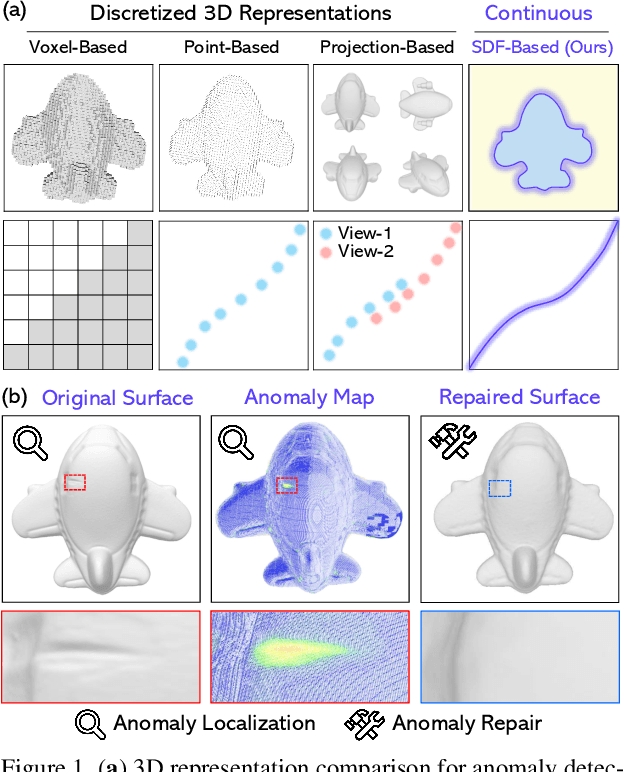
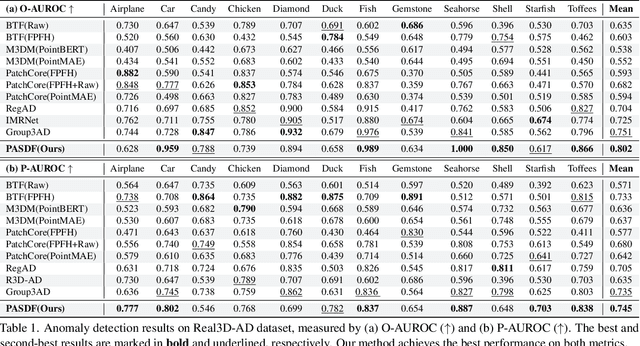
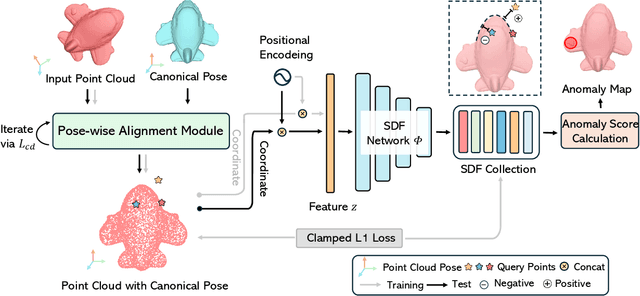
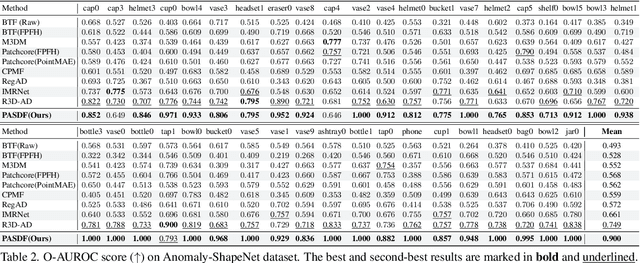
3D point cloud anomaly detection is essential for robust vision systems but is challenged by pose variations and complex geometric anomalies. Existing patch-based methods often suffer from geometric fidelity issues due to discrete voxelization or projection-based representations, limiting fine-grained anomaly localization. We introduce Pose-Aware Signed Distance Field (PASDF), a novel framework that integrates 3D anomaly detection and repair by learning a continuous, pose-invariant shape representation. PASDF leverages a Pose Alignment Module for canonicalization and a SDF Network to dynamically incorporate pose, enabling implicit learning of high-fidelity anomaly repair templates from the continuous SDF. This facilitates precise pixel-level anomaly localization through an Anomaly-Aware Scoring Module. Crucially, the continuous 3D representation in PASDF extends beyond detection, facilitating in-situ anomaly repair. Experiments on Real3D-AD and Anomaly-ShapeNet demonstrate state-of-the-art performance, achieving high object-level AUROC scores of 80.2% and 90.0%, respectively. These results highlight the effectiveness of continuous geometric representations in advancing 3D anomaly detection and facilitating practical anomaly region repair. The code is available at https://github.com/ZZZBBBZZZ/PASDF to support further research.
Visual Anomaly Detection under Complex View-Illumination Interplay: A Large-Scale Benchmark
May 16, 2025The practical deployment of Visual Anomaly Detection (VAD) systems is hindered by their sensitivity to real-world imaging variations, particularly the complex interplay between viewpoint and illumination which drastically alters defect visibility. Current benchmarks largely overlook this critical challenge. We introduce Multi-View Multi-Illumination Anomaly Detection (M2AD), a new large-scale benchmark comprising 119,880 high-resolution images designed explicitly to probe VAD robustness under such interacting conditions. By systematically capturing 999 specimens across 10 categories using 12 synchronized views and 10 illumination settings (120 configurations total), M2AD enables rigorous evaluation. We establish two evaluation protocols: M2AD-Synergy tests the ability to fuse information across diverse configurations, and M2AD-Invariant measures single-image robustness against realistic view-illumination effects. Our extensive benchmarking shows that state-of-the-art VAD methods struggle significantly on M2AD, demonstrating the profound challenge posed by view-illumination interplay. This benchmark serves as an essential tool for developing and validating VAD methods capable of overcoming real-world complexities. Our full dataset and test suite will be released at https://hustcyq.github.io/M2AD to facilitate the field.